
Fare Wells
Anita & Matt's farewell talks, Aspen Hills Ward, April 26, 2026

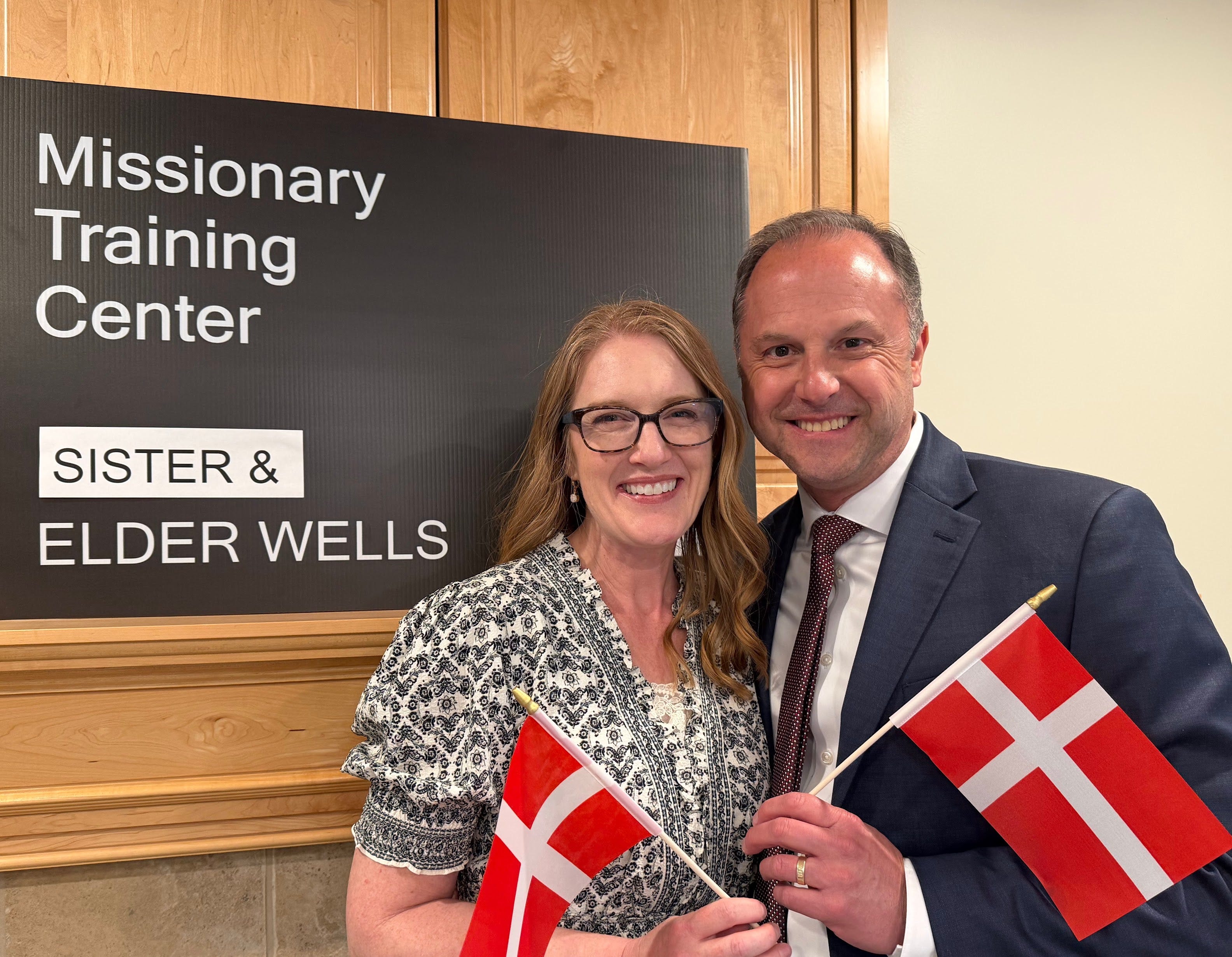
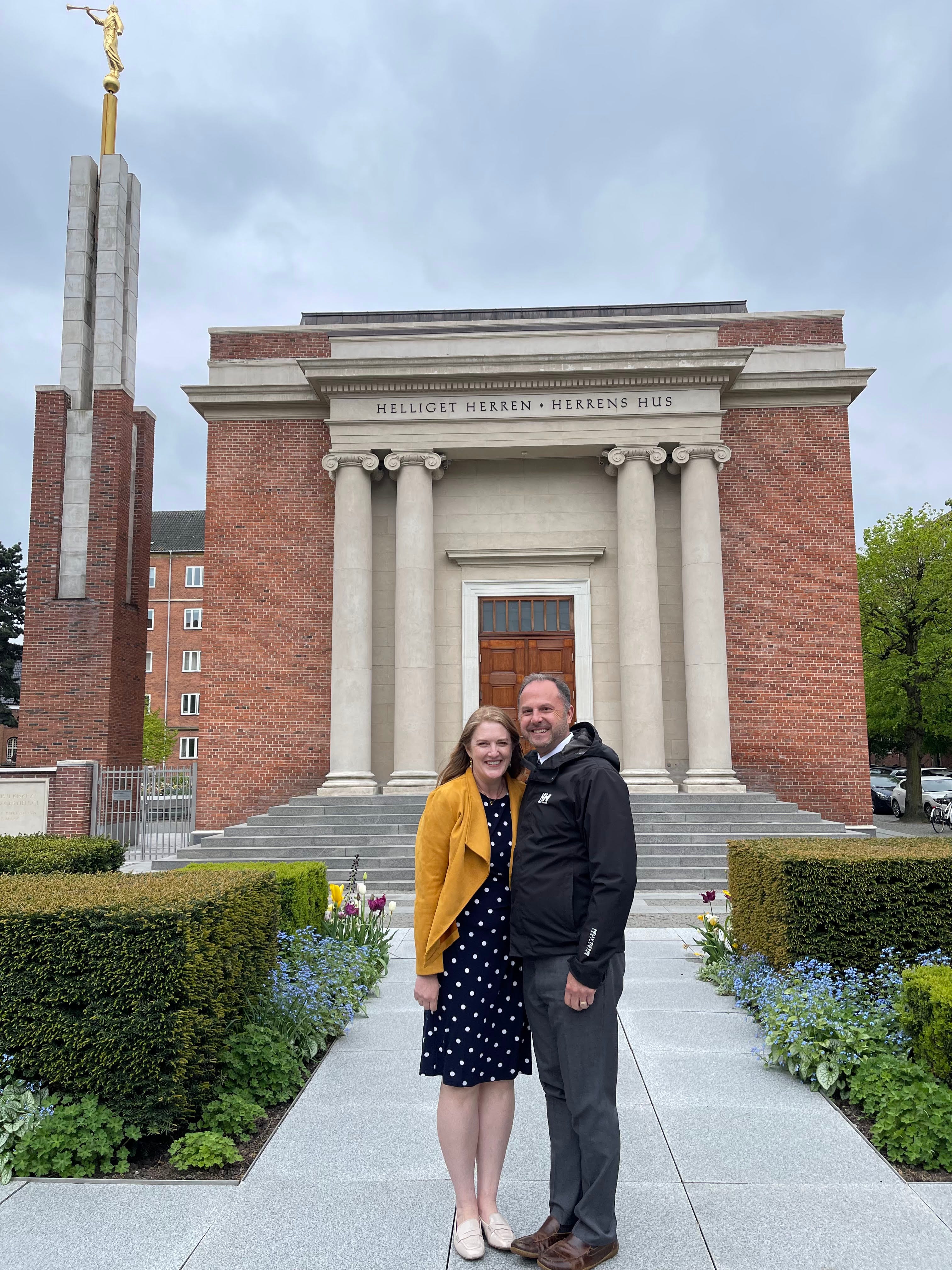
Welcome to our monthly missionary emails! Matt and I are headed out tomorrow to serve for 12 months in the Copenhagen Denmark temple. A huge thanks for all the love and support. Thanks for showing up last week, and for all who brought plates of food, and gave us hugs, and prayed for our visa, and wished us well. It has sustained us through the challenges of leaving home and family.
Below I’ve attached the texts of our Sacrament Meeting talks this past Sunday, Anita’s first and Matt’s second in the order we spoke. But the true highlight was the musical number in between, the Scandinavian hymn God’s Gracious Love (our son Nathaniel and son in law Peter singing a duet accompanied by daughter in law Reilly on the cello):
ANITA’S FAREWELL TALK: HEAVENLY HYGGE
Good afternoon, sisters and brothers. What a glorious sight to see so many family and friends here! And welcome to those joining us on zoom. Thank you for worshiping together. I hope that you feel the love of the Lord this Sabbath day.
You may wonder, what are we doing up here giving missionary farewell talks? We aren’t the age of the usual junior or senior missionaries. Well, we actually opened our call on the day they lowered the age for the young sister missionaries, so we joke that they lowered the age for seniors, too.
For those here who aren’t members of our faith, a mission is a time set apart to leave your normal life and serve God. In the Old Testament, some sacrifices were required, and some were freewill offerings. This is a freewill offering. Yet in many ways, it is a sacrifice nonetheless. It has been a lot of work to put our life on pause! We recognized a lull in our family life. And we felt guided in this direction– to serve. And we were called to do so, and assigned to the Copenhagen Denmark temple. Senior missionaries have a lot of different options for how they will spend their time, based on their abilities and skills and interests. Having worked in the temple here in Draper, we have a good sense of what our responsibilities will be there. The temple is a place to make promises with the Lord, to learn more about God and to become a holy people. The temple is a place of relationship, and ritual, both for ourselves and our deceased ancestors. We will be in both set apart time and set apart space, consecrating our lives more fully to the Lord. And we feel very humbled to offer our lives in this sacrifice. We are far from perfect, but I recognize that God has always had to work with very human and flawed servants. As Elder Kearon just said in general conference: “He needs you, and He needs me. Life is better—everything is better—when we are about His business.”
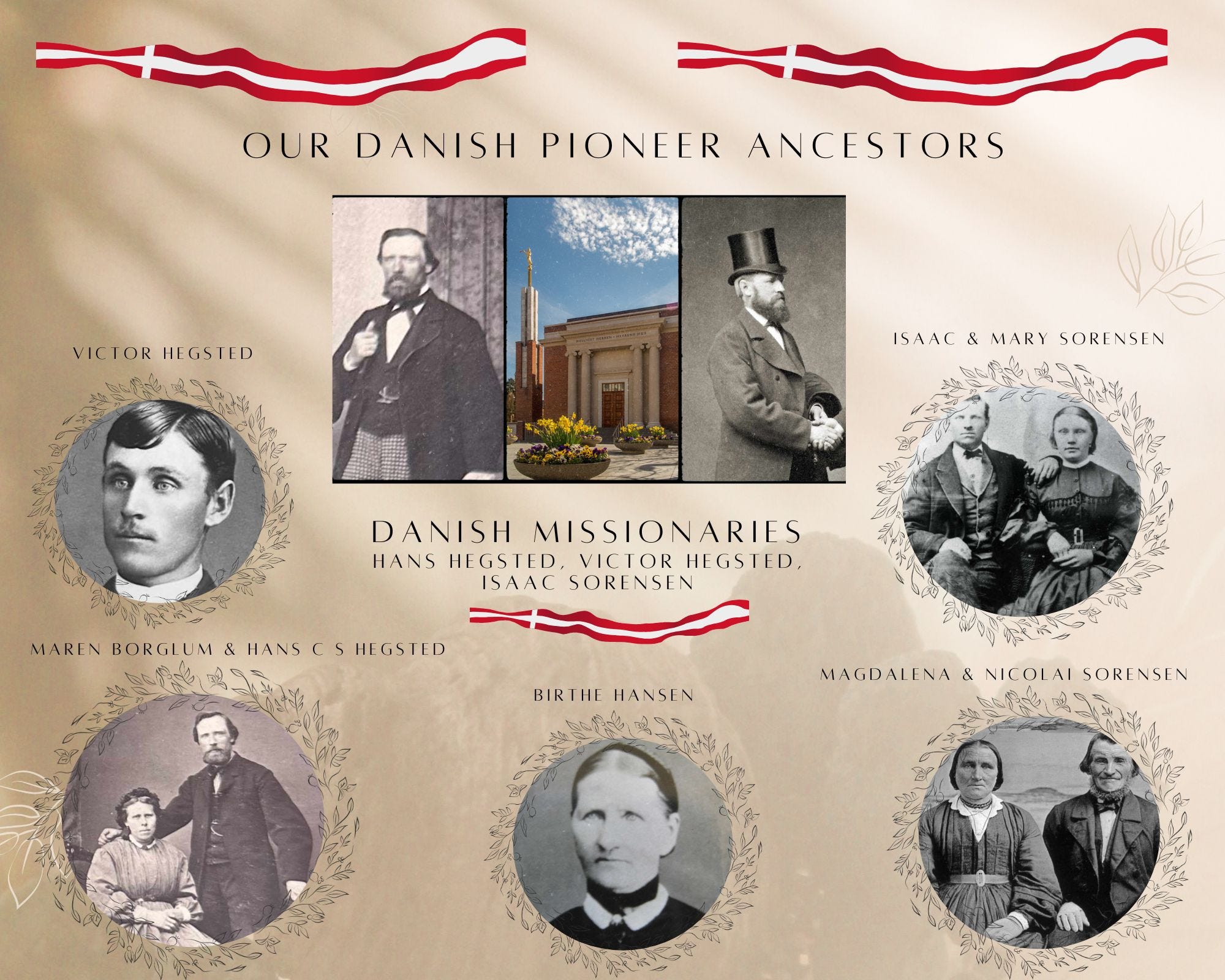
In the scriptures we often see the Lord asking people to leave their homelands–to begin a new journey towards Him. This call has been a blessing, and also a challenge to learn to speak Danish! Matt and I each have a Danish great-grandparent, and three pioneer ancestors who returned to serve missions in Denmark. About a dozen years ago, we were visiting their homeland there, and I was excited to take photos of the Lutheran church where one ancestor was baptized as a baby. In what was perhaps my only ancestral reprimand, I had a sharp feeling come to mind. It was as if he was saying–I spent years of my life preaching against this state-sponsored religion. All I wanted to do was come to Salt Lake City and worship freely with the saints at the temple. Why did you leave Utah to come see this?
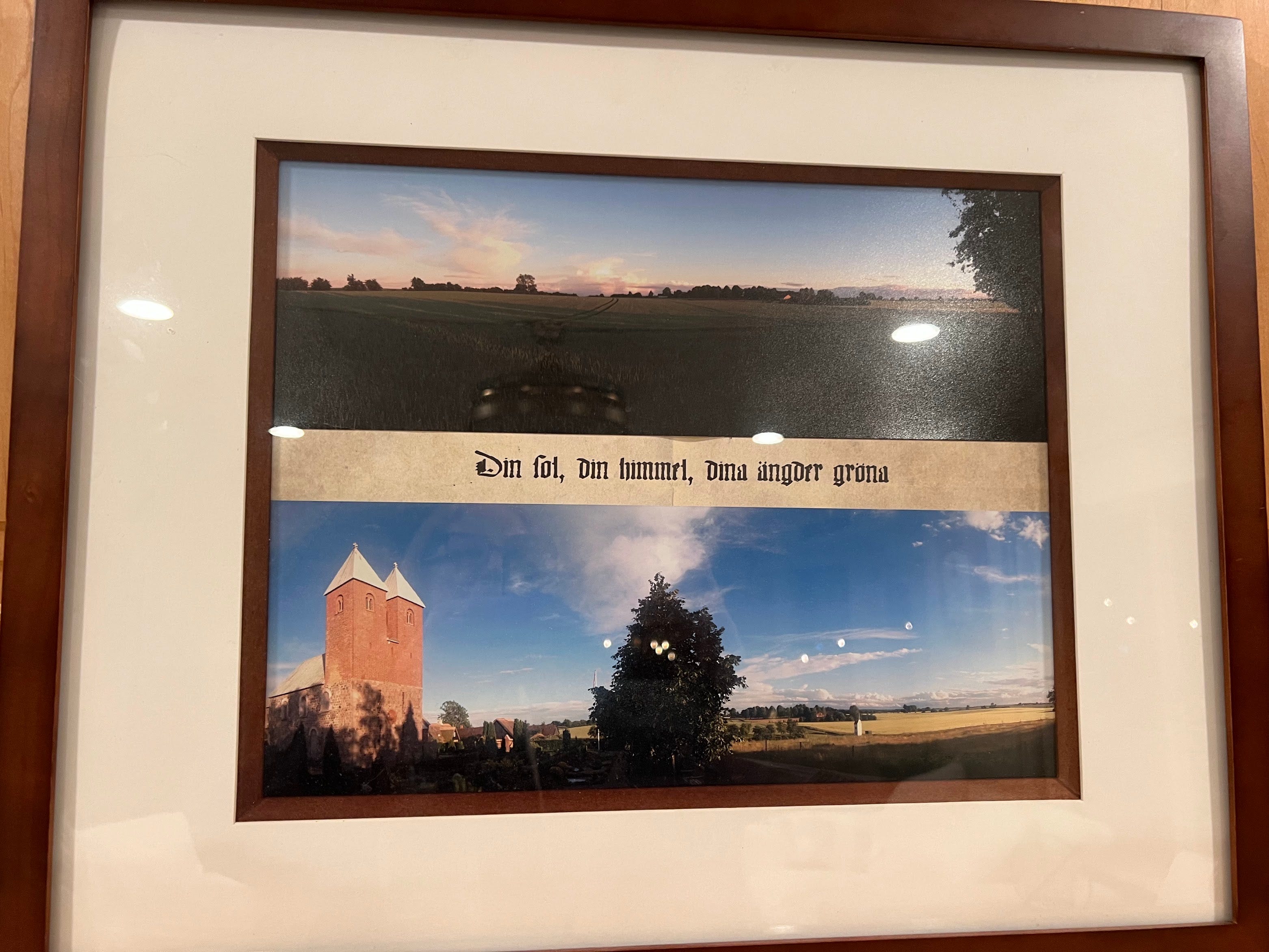
Why are we now leaving Salt Lake City to go back? This picture hangs in our home. It is a different Danish ancestors’ farmland and village church, and the lines from a Scandinavian hymn1 that say: “your sun, your heaven, your fields of green.” The last lines of that hymn say, “I want to live, I want to die in the North.” But these Sorensens were willing to leave all of that behind, because the gospel was more important. They left farms with ocean views and Viking ruins and prosperous circumstances to live in a small cabin in Utah where they didn’t speak the language. I think of that often now–as we prepare to leave our comfortable home to live in a one bedroom apartment with Ikea furniture. where we will struggle to speak the language.
It is very full circle–one eternal round. Leaving home, going home–yet all places are just temporary homes en route to our heavenly home. Working in the Draper temple the past couple of years, I have seen how the house of the Lord can truly become the home of the Lord. There’s a line in one of the new hymns2 that says, “O may Thy house be mine abode And all my work be praise! There would I find a settled rest While others go and come—No more a stranger, nor a guest, But like a child at home.” That’s how I feel about the temple these days, that I am a child in my parents’ home where I see God’s love and mercy made manifest day after day.
There are phrases in the New Testament that really speak to me on this topic. We are agents for Jesus, as Corinthians says–”laborers together with God, helpers of your joy, and ambassadors for Christ in the ministry of reconciliation”3. The temple worker handbook promises that we will find in our lives as a result of our service a refining influence, greater power over the increasing influence of the adversary, added understanding to further purify discipleship, and the power to change. These promises extend to our families as well. I truly feel like my best self there.
We recently studied Jacob’s ladder–a dream he had in Bethel, which means the House of God. The idea of a ladder connecting heaven and earth, a conduit for spirits, is an image I love to see in connection with the temple. Imagine the heavenly conduits all over the earth, the grand junction of the two worlds, with spirits going back and forth. That’s been my experience in the temple. In the section of Exodus that we are studying for Come Follow Me this next week, the Israelites were given instructions on how to build the tabernacle and worship God. One interesting verse stands out to me in Exodus 38:8: “They made the bronze basin and its bronze stand from the mirrors of the women who served at the entrance to the tent of meeting.” That means the women gave up their mirrors to build the laver, or the font. Although we don’t give up our mirrors to build baptistries today, that is symbolic to me of choosing God over our own reflection, and our own priorities and valuables.
We don’t worship the building, but temples are a structure, a scaffolding, to bring us to Christ. At altars we covenant to keep Christ’s sacrifice, along with our own sacrifices, at the center of our relationship for eternity. It is his home that I am grateful to serve in.
We spent our first married years worshipping at the Washington DC temple. For those of you who haven’t been inside, there’s a long walkway bridge between the recommend desk and the rest of the building. A friend there shared that she and her husband always stop to read a particular verse from the Kirtland temple dedicatory prayer at that bridge. I try to remember this verse as I exit temples now. D&C 109:22 reads: “And we ask thee, Holy Father, that thy servants may go forth from this house armed with thy power, and that thy name may be upon them, and thy glory be round about them, and thine angels have charge over them.” I love the idea that angels are with us as we leave the temple.
One place I feel a strong connection to the divine is at the temple veil that leads to the celestial room. In Hebrews4 we read: “Let us therefore come boldly unto the throne of grace.” Anciently, to reach the throne of God, the ark of the covenant, one had to pass through the veil of the temple. However, only one man, the high priest, was allowed to enter the Holy of Holies. And only once a year, on the Day of Atonement. But when Christ died, the veil of the temple was torn from top to bottom. The way was opened. Not just for one, but for all. Hebrews5 teaches that the veil represents Christ’s body. Through Him, we are invited into God’s presence. We come with our covenants and our faith, and Jesus, through His atoning sacrifice, advocates for us. The veil is the lens our Heavenly Parents see us through. In that sense, we are daily practicing eternal life.
Recently, I was helping a woman in a wheelchair approach the veil. It took more time than usual and required some complicated maneuvers. As I watched her struggle, but also enter the celestial room with joy, I thought we are all approaching the Lord with our own challenges and disabilities, some more visible than others, and our heavenly parents welcome us home. The handicapped woman at the veil is all of us. And everyone in that company is welcomed in and welcomed home.
As a parent of young adult kids who live far away, I am always grateful when I get to spend some time with them. It is a delight to welcome them home again. I know our Heavenly Parents also want to spend time with us, and want us to come home to them. In this way, the House of the Lord can become the home of the Lord as we visit often. There is a Scandinavian concept you’re probably familiar with called hygge. Especially in the dark winter months, the people there focus on creating a cozy, warm atmosphere that fosters contentment, togetherness, and well-being. It involves appreciating life’s simple pleasures—like candlelight, and good company—to reduce stress and enhance happiness. I like the idea that the temple can provide us with heavenly hygge. When the world seems dark and stressful, I love turning my phone off and avoiding its notifications for hours at a time. At the temple we can bask in being present. And in a divine presence. I love the light, the peace, the smiles, the joy. Heavenly hygge is always a good idea.
Every morning, the sun rises. We don’t even wonder if it will happen today or tomorrow, we know it will. This daily testimony of the resurrection is powerful to me. The Son of God rose to give us eternal life. We can count on that just like daily sunrise. As a faith we really put our money where our mouth is with our belief in the resurrection. We spend millions of hours and millions of dollars on temple work. President Hinckley put it more eloquently: “Temples stand as a witness of our conviction of immortality. They are living, working testimonies to our faith in the reality of the resurrection of our Lord, Jesus Christ.”
It is an impossible glorious project of making every human being in history known and sacred, and also being sanctified ourselves in the process. The temple stands at the center of God’s unfolding story. It is where heaven touches earth, where divine love takes form, and where humanity is invited home to the presence of God. From Eden to Solomon, from the wilderness tabernacle to the temple in Draper and Copenhagen, the message is the same: God desires to dwell with His people and fill their lives with His covenant love. The temple’s purpose, beautified by sacred architecture, is a testament that all creation can be holy ground. God’s goal has always been to dwell with His people, not apart from them. When we keep our covenants, our homes become sanctuaries. When we forgive, serve, love, and worship, we re-create temple space wherever we are.
I love the verse in 2 Nephi 22 6that says: “Behold, God is my salvation; I will trust, and not be afraid; for the Lord Jehovah is my strength and my song; he also has become my salvation. Therefore, with joy shall ye draw water out of the wells of salvation.” The wells of Jesus, the living water, can be found in the temple, where the house of the Lord truly becomes the home of the Lord. The power of God is manifest daily there. I hope you can see its blessings in your life, and find heavenly hygge.
I appreciate my kids doing this musical number, a Scandinavian hymn 7whose lyrics have been restorative to my soul. They say in part:
Day by day, Thy strength will bear me kindly Till I reach the promised land. –our eternal home.
Until we meet again, I say these things in the name of Jesus Christ amen.
https://en.wikipedia.org/wiki/Du_gamla,_du_fria
https://www.churchofjesuschrist.org/media/music/songs/my-shepherd-will-supply-my-need?lang=eng
1 Cor 3:9: for we are labourers together with God; 2 Cor 1:24: helpers of your joy
2 Cor 5:20: now we are ambassadors for Christ in the ministry of reconciliation
Hebrews 4:16
Hebrews 10:19-20 “Having therefore, boldness to enter into the holiest by the blood of Jesus, By a new and living way, which he hath consecrated for us, through the veil, that is to say, his flesh.”
2 Nephi 22:2-3
https://www.churchofjesuschrist.org/media/music/songs/gods-gracious-love?lang=eng
MATT’S FAREWELL TALK
I’m so grateful for the music from my dear family and the spiritual insights from Anita. She inspires me daily and I love her scholarship and testimony. I’m also grateful to share my love of temples with you today—and my ongoing surprise to be departing for Denmark in eight days!
Sometimes, I’m not sure why I’m surprised since Anita and I have certainly been blessed with many role models of parents, grandparents and extended family members serving as temple ordinance workers. We similarly have many role models of senior missionaries, including my parents having served three missions overseas and Anita’s parents currently serving in London. We even know many midcareer professionals taking time to serve as mission leaders, including President Newitt and my first law firm boss and bishop in Palo Alto, Elder Mark Bonham, who is with us today and has been a great mentor and example to me for more than 25 years.
Still, just a few months ago, I never would have imagined taking a sabbatical from my law practice to serve a senior mission at 56 and, despite Anita’s temple service, my mental image of senior temple missionaries is of angelic retirees who seem more seasoned both in years and prior service than I feel. So, how did we get here?
Bishop Quilter told us that our decision to take this step at this age might encourage others to explore similar opportunities and there is a great need for senior missionaries around the world. It has certainly been true that many friends and co-workers, particularly other temple workers, have wanted more details about the process and our decision. I will also say that, although we won’t be proselyting, I have received particularly warm comments from clients and co-workers who are not of our faith, including a legal secretary at my firm (with whom I have practically no contact) taking the time to reach out to say:
“I’ve seen too many attorneys work way too much for way too long and ultimately regret not taking a little more time for themselves and their families along the way. Makes me happy to see someone be willing to take a break from legal work to do something personally meaningful.”
In the next 10 minutes, I’d like to briefly touch on two questions, (1) why this mission and (2) why now?
Anita mentioned we recognized a lull in our life and felt guided to serve. In addition to local possibilities listed on JustServe.org, googling “Senior Missionaries” led us to a super-helpful portal summarizing ways to serve, types of assignments, FAQs and a database of current needs under “search opportunities.”
The challenge for me was that, while I could imagine Anita being great in practically all areas, from “teach and fellowship” to “family history support” to “seminaries and institutes” and seriously everything (although I’m not sure she shares the dream of one of her temple co-workers to be called to the Heber Valley Camp), I had a harder time seeing myself in any of those roles since, outside of my professional duties negotiating business deals for clients, my personality tends to be more of the quiet observer. Still, Anita reminded me of the scripture that says “For all have not every gift given unto them; for there are many gifts” and when I came across the listings for “serve in a temple,” I felt a peaceful assurance that welcoming God’s children to the House of the Lord and “helping them feel the sacred Spirit of the temple” was something I could do.
Very briefly for those unfamiliar with temples or wondering more specifically what we will be doing in Denmark, googling “What Temple Workers Do” suggested:
Temple workers are volunteers who dedicate their time to assisting patrons, with roles including:
Guiding participants through ordinances (which are sacred, formal acts or ceremonies performed by the authority of the priesthood) including baptisms for the dead, initiatory washings and anointings, the endowment, and sealing marriages and families for time and all eternity rather than “until death do you part.”
Assisting patrons with directions, finding rooms, and handling clothing in the baptistry or temple clothing desk.
Greeting patrons, assisting with special needs, and maintaining a reverent, peaceful environment.
There is just one temple in Denmark and, because the Stockholm Sweden temple is being reconstructed, the Copenhagen temple currently covers Denmark, Sweden, Norway, Iceland and Greenland and also receives many visitors from northern Germany, which will be fun for me since I served in Germany as a young missionary. We will live in a Church-provided apartment near the temple allowing us to serve in the temple five days a week (Tuesday through Saturday). We will be volunteers who will pay our own way, although housing costs are standardized and subsidized.
Why do I love temples?
Temples have been an important anchor from my earliest childhood and the fact that my current temple service is still accompanied by those childhood feelings of peace and love is certainly part of why I’m standing before you.
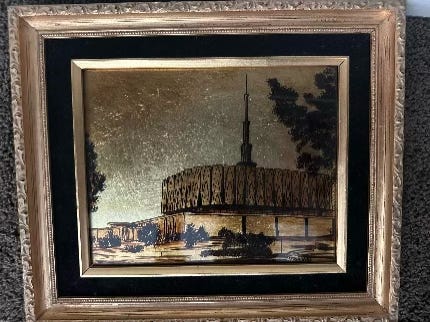
I have an image of myself as a young child studying a line painting on glass of the Provo Temple over a gold leaf background that my mother had made. In the reasoning of a child, I thought my mom must really love the temple to spend so much time honoring it in precious gold.
I was raised in Provo where my father was a professor at BYU. Every few months, my parents would pack their six little kids into the family station wagon and drive to St. George to spend time with my only living grandparent, whose father incidentally was born in Copenhagen. In addition to hiking to the old family dairy farm and hanging out with cousins, I remember many visits to, and stories about, the St. George Temple, where my dad was baptized and received his endowment.
When I was perhaps 12, our family was asked to sing Janice Kapp Perry’s new Primary Song, I Love to See the Temple, in sacrament meeting. In my young mind, this was a big responsibility to bear testimony of the temple in song and I felt the importance of singing the words very sincerely and earnestly. The second verse reads:
I love to see the temple.
I’ll go inside someday.
I’ll cov’nant with my Father;
I’ll promise to obey.
For the temple is a holy place
Where we are sealed together.
As a child of God, I’ve learned this truth:
A fam’ly is forever.
Much later, as a 25-year-old BYU student, part of my proposal to Anita included tying her engagement ring to a bookmark placed in a miniature children’s songbook at the page with that song, I Love to See the Temple. We married in the Salt Lake Temple (the day after we both graduated from BYU) and every return has deepened my love of temple work and of her.
Why serve now?
Returning to foundational experiences, less than a year after our temple marriage, I was diagnosed with cancer and ultimately underwent three rounds of chemotherapy. Anita was expecting our oldest daughter Eliza and we didn’t know if Anita would end up a widowed single mother before turning 23. In hindsight, although we had prayed long and hard about whether to get married after graduation or wait until after Anita served a mission (which she had fully saved for with babysitting money before entering BYU), I’ve often thought that her first mission was a service mission to help a cancer patient at home. It wasn’t the calling she expected but her service to that one poor soul very directly made this calling possible and that much sweeter. Gratefully, we both survived that early trial and learned several things that have shaped our marriage.
First, we learned that trials accompany the covenant path. Second, we learned that faith and love can buoy us up through hard times and bring us closer together. Third, we learned to take time to appreciate the small things, like the ability to breathe and walk, since life can be unpredictable and we might not have as much time for future plans as we hope. Although my chances of relapse after nearly thirty years in remission are statistically normal, the possibility of an early death is always with me, making it a little more urgent to seize the day. This mindset has spurred our decision to invest in travel and family time throughout my career instead of waiting for retirement and definitely contributed to our choice to embrace this opportunity to serve now.
Other contributing factors included, first, having a window with healthy parents and independent children (but no grandkids) and a flexible law firm—although we know another couple heading to Denmark to serve as member leader support missionaries despite ailing parents, an adult child with health challenges and missing their grandkids but willing to follow spiritual promptings to serve. Second, a promise in my patriarchal blessing that “you will have the privilege to work in the temple as an ordinance worker.” Third, the hope of overlapping with my brother and his family who are living in Copenhagen while he works for a Danish company. Finally, and quite candidly, my love for Anita, as she has dreamt of serving a full-time mission since young women’s and I love to see her happy.
Still, there was some uncertainty over whether we would receive this particular calling since the online posting said “Required experience includes past work as temple ordinance workers in their local temple,” which is experience I lacked. When we nevertheless decided to submit our papers, President Newitt further cautioned us that while seniors can express preferences for types of service, locations and length of service (we listed temple openings in Denmark, England and Germany for 12 months), the Lord may need us elsewhere. In fact, a week after submission, President Newitt reported that the mission department had called asking if we could serve for 18 months since they desperately needed office couples for 55 new missions—we said we had felt inspired about temple service for a year but would wait to see where we were called. When our call came and read “You are assigned to labor in the Copenhagen Denmark Temple for a period of 12 months,” we were stunned and deeply grateful.
It truly has been such a joy to witness and share in Anita’s excitement (and nervousness) at every step of this journey, reading Danish ancestor missionary journals, checking our percentages of Danish DNA and tearing up over the idea of greeting deceased Danish ancestors in Danish. I won’t pretend it hasn’t been stressful to pack up the house for my sister and her family to move in, for Anita to resign from her MWEG job, for me to transition my work clients to team members to cover during my unpaid sabbatical and for both of us to struggle to learn a little Danish—although we’re also assured that while Danes appreciate the effort, they immediately switch to English. But we’ve also seen many blessings, not least of which has been the humbling opportunity for me to train as an ordinance worker in the Draper Temple on Anita’s shift and to feel how much the Lord and his servants there deeply want everyone to feel that peace and love that I felt as a child and feel each time I enter His Holy House.
Apropos, for anyone who has been meaning to go the temple more often or even for the first time, I highly recommend you seize the day.
I really do love to see the temple and know it is a holy place. I’m so grateful for our Savior, for His atonement and for this opportunity to serve. In the name of Jesus Christ, Amen.
Always the best pun maker. Wishing you safe travels! Sending all my love. ❤️
And I will look forward to your weekly/monthly updates!